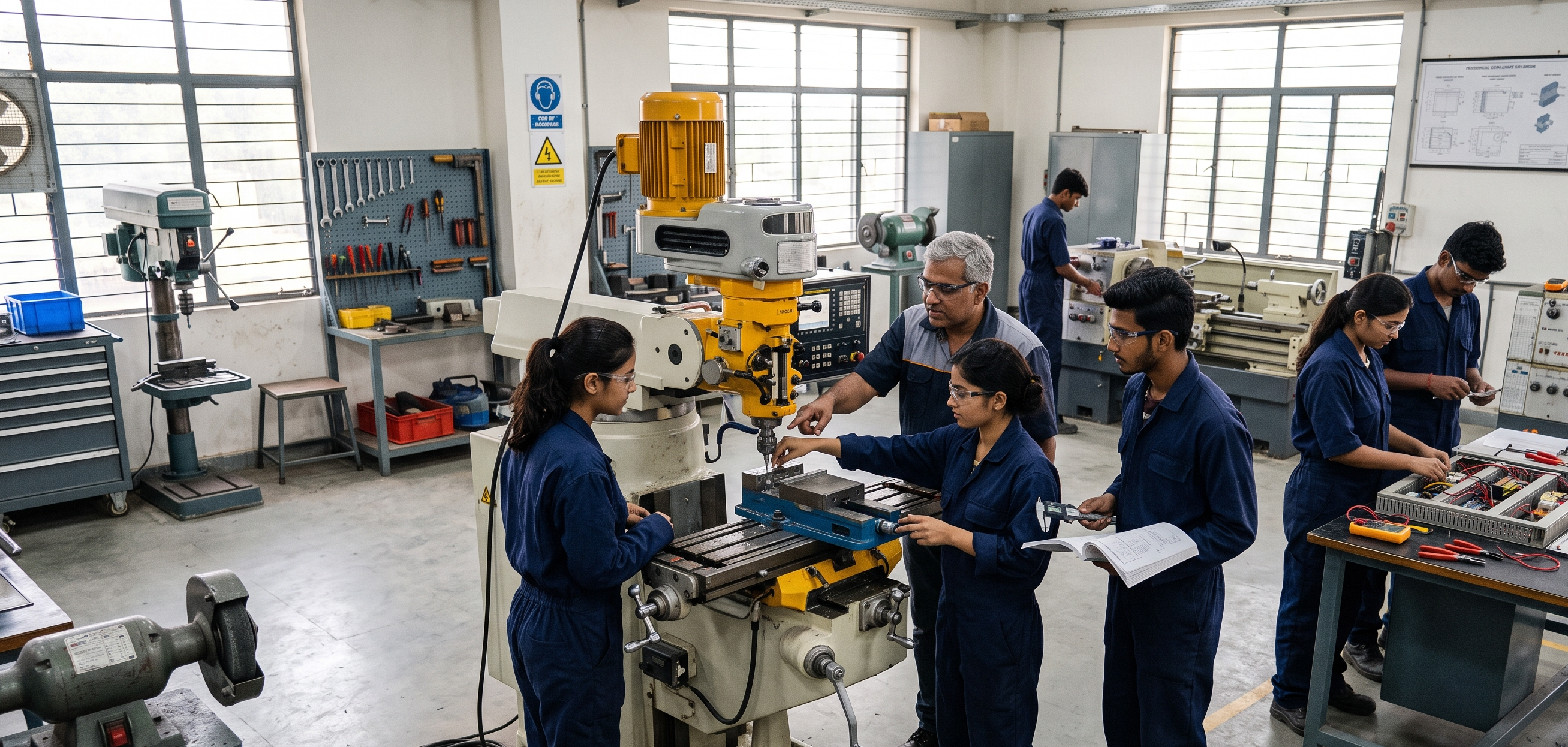
The benefits of industrial education go well beyond learning how to operate equipment or complete a technical course. Good industrial education connects classroom knowledge with practical work, current industry requirements, workplace safety, and the habits employers expect from new professionals. For students and working learners, this can mean stronger employability, better access to specialised roles, greater confidence on the job, and a clearer path toward long-term career advancement.
The difference becomes especially noticeable when training includes practical labs, industry exposure, technical projects, and guidance from people who understand actual workplace conditions. A student may understand a concept in theory, but being able to apply it correctly when a machine, process, or deadline is involved is another matter entirely.
How Does Industrial Education Boost Employability?
One of the biggest benefits of industrial education is its direct connection with employment. Industrial education programmes are generally built around skills that have a practical use in a workplace. Instead of spending the entire learning period on theory, students get opportunities to practise procedures, use tools, understand equipment, follow safety requirements, and solve work-related problems.
That practical exposure can make the transition from education to employment less difficult.
Consider a student entering manufacturing. Knowing the definition of quality control is useful, but employers also want someone who can inspect a component, understand a measurement, identify a deviation, and report the issue correctly. Similarly, an electronics student may understand circuits academically, yet employers need someone who can use testing equipment and troubleshoot an actual fault.
This is where practical learning earns its value.
Industrial education can also help students understand workplace expectations that are not always obvious from a textbook. Punctuality, documentation, teamwork, communication with supervisors, safe equipment handling, and following standard operating procedures all matter.
At Accurate Group of Institutions, for example, career-oriented technical learning can be strengthened when classroom concepts are supported by practical laboratory work, project-based activities, technical demonstrations, and exposure to professional expectations.
Employability is not simply about getting the first interview. It is also about being able to perform once selected.
What Practical Skills Do Industrial Programs Offer?
The practical skills offered through industrial education depend on the programme, sector, and level of training. However, most industry-focused programmes aim to build a combination of technical competence and workplace application.
Students may learn to operate machinery, read technical drawings, use measuring instruments, work with electrical or electronic systems, understand production processes, analyse data, or use software relevant to their field.
Some programmes also introduce students to:
Precision engineering: Measurement, tolerances, machining processes, technical drawings, and accurate component production.
Quality control: Inspection procedures, documentation, defect identification, process monitoring, and quality standards.
Automation: Industrial controls, sensors, robotics, programmable systems, and human-machine interfaces.
Digital tools: CAD software, data-entry systems, industry-specific applications, spreadsheets, and digital documentation.
Safety procedures: PPE, machine safety, electrical safety, emergency response, housekeeping, and workplace risk awareness.
Production practices: Lean principles, workflow management, preventive maintenance, inventory awareness, and process improvement.
The useful part is not simply knowing what these terms mean.
A student needs to practise them.
For instance, learning CAD becomes more valuable when a learner has to create or modify an actual component drawing. Similarly, learning quality control becomes more meaningful when students inspect a physical part and have to decide whether it meets the required specification.
Industrial laboratories should therefore be more than rooms filled with equipment. The equipment needs to be used. Students should make mistakes, check measurements, repeat procedures, ask questions, and understand why one method works better than another.
Industry also changes quickly. Automation, data systems, artificial intelligence, advanced manufacturing, and digital monitoring are changing technical roles. Consequently, good industrial education needs to update its practical learning alongside these changes instead of relying entirely on old equipment or outdated processes.
How Does Industrial Training Lead to Higher Earning Potential?
Industrial training can improve earning potential by helping learners develop specialised skills that employers need. However, it is important to be realistic here: completing a technical programme does not automatically guarantee a high salary.
Earnings depend on the industry, location, qualification, experience, technical specialisation, employer, and the level of responsibility a professional can handle.
Still, specialised practical skills can create stronger career opportunities.
A technician who understands automated production equipment may have access to different roles than someone trained only in basic machine operation. Likewise, an individual with skills in industrial electrical systems, CNC operations, robotics, quality inspection, or technical maintenance may be able to move into more specialised positions after gaining experience.
Industrial education can also reduce the amount of basic workplace training a new employee requires. A graduate who already understands workshop discipline, safety procedures, measurement techniques, technical documentation, and common equipment may adapt faster than someone who has studied the same concepts only theoretically.
Over time, this can support progression into positions such as:
Maintenance Technician
Production Technician
Quality Technician
CNC Operator or Programmer
Electrical Technician
Automation Technician
Technical Support Professional
Production Supervisor
Quality Supervisor
The route is rarely instant. Usually, it works step by step.
First comes technical competence. Then workplace experience. After that, additional certification or specialisation can open another level of responsibility.
That is often how higher earning potential develops in technical careers.
What Are the Long-Term Career Advantages of Vocational Education?
Vocational education provides an important foundation for long-term career development because it focuses on skills that can be applied directly. The learner does not simply finish a course and stop learning. In many technical careers, the initial qualification is only the starting point.
A technician may begin with basic maintenance responsibilities and later specialise in industrial automation. A production trainee may move into quality assurance. Someone with electrical training may develop expertise in control systems, renewable energy equipment, or industrial instrumentation.
The original skill set remains useful, but it expands.
This is one of the quieter benefits of industrial education. Practical training teaches people how to learn through work. Once that habit develops, additional certifications, advanced courses, manufacturer training, and workplace projects become easier to approach.
Vocational education can also support entrepreneurship. A skilled professional who understands repair, fabrication, electrical installation, machine servicing, computer hardware, or another technical area may eventually choose to provide services independently.
Professional networks matter too.
Instructors, workshop supervisors, industry mentors, classmates, internship contacts, and former colleagues can all become part of a professional network. These relationships may later help with job referrals, technical advice, collaboration, or discovering new opportunities.
For institutions such as Accurate Group of Institutions, this is why industry interaction should not be limited to a single placement event. Industry visits, guest sessions, practical projects, internships, technical competitions, and employer interaction can give students a clearer understanding of where their skills can lead.
Career advancement is usually easier when students can see the next step.
Why is Continuous Learning in Industrial Sectors Crucial?
Industrial sectors do not remain still.
Machines become more automated. Software changes. Production systems become more connected. Safety standards evolve. Companies introduce new equipment, and workers have to understand it without starting their careers again from zero.
That is why continuous learning is one of the most important long-term benefits of industrial education.
A technician trained several years ago may now need knowledge of digital monitoring systems, automated controls, data interpretation, robotics, or new safety procedures. A manufacturing professional may need to understand lean production, predictive maintenance, or connected production systems.
The point is not that every worker needs to become a software engineer.
Rather, technical professionals need to remain comfortable with change.
Continuous learning can happen through several routes:
Short-term certification programmes
Manufacturer-specific equipment training
Advanced vocational courses
Workplace workshops
Technical seminars
Safety and compliance training
Online technical learning
Professional certifications
Cross-training within an organisation
For employers, this creates a workforce that can adapt as processes change. For employees, it reduces the risk of becoming dependent on skills that are no longer widely required.
There is also a practical career benefit. Employees who keep developing relevant skills may become suitable for broader responsibilities because they can handle more than one part of a technical process.
That matters when promotions are being considered.
A person who can operate equipment, understand quality data, communicate with maintenance teams, and help train new employees is naturally positioned differently from someone who can perform only one narrow task.