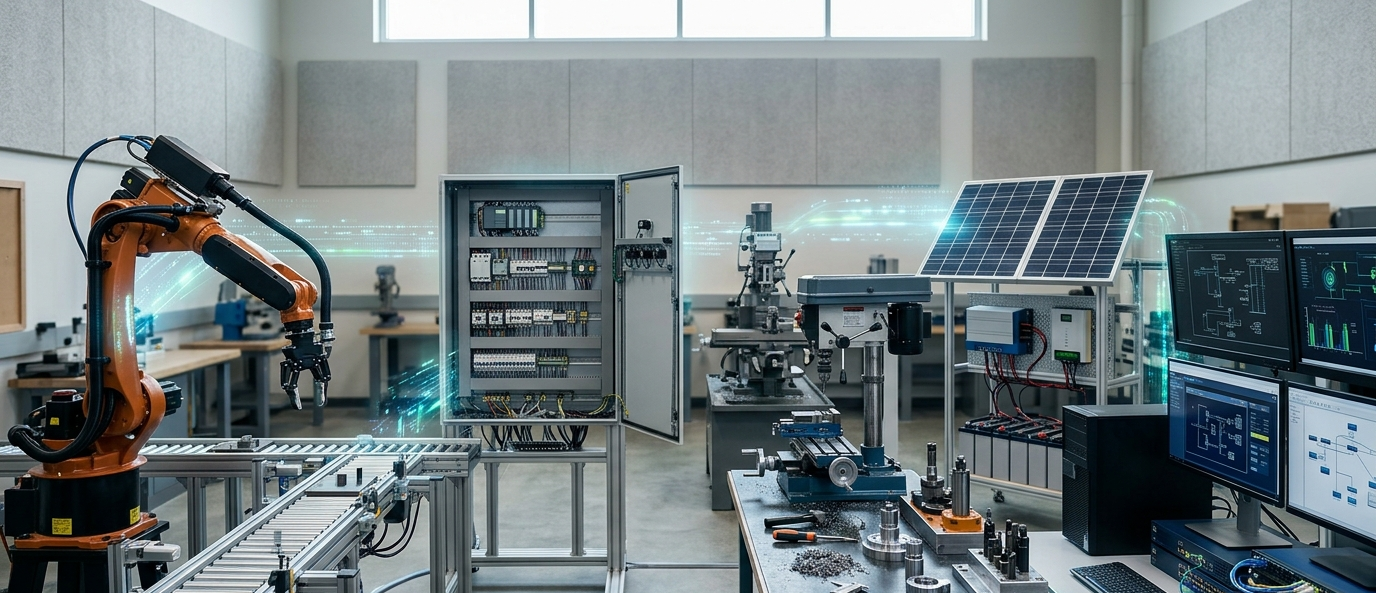
Gateway to Specialization: Key Programs and Paths in Industrial Education
Industrial education has changed significantly. It is no longer limited to traditional workshop trades or basic technical training. Today, students can specialise in areas such as advanced manufacturing, robotics, electrical technology, renewable energy, cybersecurity, software development, and data systems.
That wider choice is useful, but it can also make the decision harder. A student interested in technology may not know whether to choose automation, IT, cybersecurity, or engineering technology. Someone interested in hands-on work may have to decide between electrical systems, manufacturing, fabrication, or renewable energy.
This is where specialised industrial education programs become important. Instead of trying to learn everything, students can build deeper knowledge in one technical area and develop the practical skills required for specific roles.
For students exploring career-focused education, the real question is not simply which specialization sounds interesting? It is whether the program provides the right combination of theory, laboratory practice, technical tools, industry exposure, and recognised credentials.
What Are the Main Specializations in Industrial Education?
The key programs in industrial education generally fall into several technical areas. The exact course names differ between institutions, but the underlying skills remain relatively consistent.
Major specializations include:
- Advanced manufacturing
- Automation and robotics
- Electrical and electronics technology
- Welding and fabrication
- Renewable and sustainable energy
- Information technology
- Cybersecurity
- Networking and cloud technologies
- Software and digital systems
- Industrial maintenance and instrumentation
Each pathway has a different technical focus.
For example, an advanced manufacturing program may involve CNC machining, CAD/CAM, quality inspection, and production systems. Automation programs can introduce PLC programming, sensors, motor controls, robotics, and industrial communication systems. Meanwhile, IT-focused programs may cover networking, databases, programming, cloud platforms, and cybersecurity.
That distinction matters when selecting a course. A student should look beyond the program title and examine the actual modules, laboratory work, equipment, software, certifications, and practical projects included.
Advanced Manufacturing and the Move Toward Industry 4.0
Advanced manufacturing is one of the most technology-intensive areas within industrial education. Modern production facilities increasingly combine mechanical systems with automation, software, sensors, data, and connected equipment.
Therefore, students entering this field need a broader technical foundation than simply learning how to operate a machine.
What Do Students Learn?
Depending on the program, students may work with:
- CNC machines
- Computer-aided design and manufacturing
- Industrial sensors
- Automated production systems
- Quality-control equipment
- Robotics
- Industrial data systems
- Additive manufacturing and 3D printing
A strong program should allow students to understand the relationship between these technologies. For example, learning CAD is more useful when students also understand how a digital design moves into manufacturing. Similarly, learning CNC operation becomes more meaningful when students understand tooling, measurements, machine settings, tolerances, and quality checks.
Understanding Industry 4.0
Industry 4.0 refers to the increasing use of connected and intelligent technologies in manufacturing. These include the Internet of Things, industrial data analytics, automation, robotics, cloud systems, and smart production technologies.
Industrial education supports this transition by teaching students how these systems operate together.
Students may also encounter concepts such as predictive maintenance, digital twins, lean production, and real-time monitoring. These are not just buzzwords. In practical settings, they relate to questions such as when equipment needs servicing, how production problems can be identified earlier, and how data can help improve efficiency.
For anyone considering advanced manufacturing, the important thing is to develop both technical operation skills and troubleshooting ability.
Automation and Robotics Programs: From Machines to Intelligent Systems
Automation and robotics have created another specialised pathway within industrial education.
A modern automated system can involve mechanical components, electrical circuits, sensors, controllers, software, and communication networks. Because of that, automation students often need knowledge from several technical disciplines.
Key Skills in Automation Education
Typical areas may include:
- PLC programming
- Industrial robotics
- Sensors and actuators
- Motor controls
- Pneumatic and hydraulic systems
- Industrial control panels
- Human-machine interfaces
- Industrial communication systems
Practical training becomes especially important here.
A student might learn PLC logic in the classroom, but understanding how that logic behaves when connected to an actual motor, sensor, or conveyor system requires hands-on practice. Similarly, programming a robot is only one part of the job. Students also need to understand safety, positioning, system integration, fault detection, and maintenance.
That is why students comparing automation programs should ask about the actual laboratory setup. A useful lab should provide opportunities to test systems, identify faults, modify programs, and understand how individual components interact.
Electrical and Electronics Technology
Electrical and electronics technology remains a fundamental specialization because almost every modern industrial environment depends on electrical systems.
Programs can cover areas such as:
- Industrial wiring
- Electrical circuits
- Motor controls
- Power systems
- Control panels
- Digital electronics
- Instrumentation
- Electrical safety
- Testing and measurement
Practical work should complement theoretical concepts. Students may need to use multimeters, oscilloscopes, control components, wiring systems, testing equipment, and other technical instruments.
For example, understanding a motor-control circuit on paper is different from wiring and testing that circuit in a controlled laboratory environment. Students need to understand what happens when a component fails, how to identify the fault, and how to test the system safely.
This combination of electrical knowledge and diagnostic ability can be useful across manufacturing, construction, maintenance, energy, automation, and other technical industries.
Welding, Fabrication and Industrial Production Skills
Welding and fabrication represent another practical specialization within industrial education. These programs focus heavily on material handling, joining processes, workshop safety, measurements, and fabrication techniques.
Students may learn different welding processes, depending on the course and equipment available, along with:
- Metal preparation
- Technical drawings
- Measurements and tolerances
- Welding safety
- Joint preparation
- Fabrication techniques
- Inspection and quality control
- Equipment maintenance
The quality of practical training matters greatly in this field. Students need repeated practice to develop control, accuracy, consistency, and safe working habits.
Professional certifications can also become relevant. However, students should check which certification body and credential applies to their intended occupation and country rather than assuming that every welding certification has the same recognition.
Renewable Energy and Sustainable Technology Programs
The growth of renewable energy has also expanded opportunities for specialised technical education.
Programs in this area can cover:
- Solar photovoltaic systems
- Battery storage
- Electrical energy systems
- Energy efficiency
- Solar installation and maintenance
- Energy auditing
- Renewable energy system design
- Green building technologies
Practical learning can involve equipment used to understand solar generation, electrical connections, energy measurement, battery systems, and system performance.
This area is particularly interesting for students who want to combine electrical or engineering skills with emerging energy technologies. However, they should also examine the technical depth of a course. A program focused only on basic installation will provide a different skill set from one covering system design, electrical engineering principles, energy management, and advanced storage technologies.
Information Technology, Cybersecurity and Digital Specializations
Industrial education increasingly overlaps with IT because manufacturing, logistics, energy, healthcare, and other industries rely heavily on digital infrastructure.
Students can specialise in areas such as:
- Network administration
- Cybersecurity
- Cloud computing
- Software development
- Database management
- Data analytics
- IT support
- Industrial software systems
These programs require a different kind of practical environment. Instead of only physical machinery, students need access to computers, network equipment, virtual machines, development environments, databases, and security tools.
For example, a cybersecurity student should ideally practise identifying vulnerabilities, configuring security controls, analysing logs, and responding to simulated incidents. A networking student should work with routing, switching, IP addressing, network troubleshooting, and infrastructure configuration.
Similarly, software students benefit from building actual applications instead of only memorising programming concepts.
The focus should remain on doing, testing, troubleshooting, and improving.
How Industry Exposure Strengthens Specialised Learning
Specialisation becomes more useful when students understand how their technical skills are applied outside the classroom.
Industry exposure can take several forms:
- Technical workshops
- Expert sessions
- Internships
- Apprenticeships
- Industrial visits
- Live projects
- Technical competitions
- Employer interaction
These experiences can help students understand workplace expectations before they enter a full-time role.
For example, a student studying automation may understand PLC programming academically but gain a different perspective after observing an actual production line. Similarly, an IT student can better understand infrastructure management after working with a real network environment.
Practical learning, technical facilities, projects, expert interactions, and industry-oriented activities can play an important role in career-focused education. Students should still evaluate the specific program they are considering by checking its curriculum, laboratory facilities, faculty expertise, practical hours, and opportunities for industry exposure.
How Should Students Choose the Right Specialization?
Choosing a specialization should start with the kind of work you want to perform.
If you enjoy machines and production systems, advanced manufacturing or automation may be relevant. If electrical circuits and control systems interest you, electrical technology could be a better fit. Students who enjoy computers may explore networking, software, data, or cybersecurity.
Then look at the curriculum in detail.
Ask:
- What technical subjects are taught?
- How much practical training is included?
- Which machines, tools, and software are available?
- Are projects part of the course?
- Are internships or industrial visits offered?
- Which certifications are relevant?
- What qualifications are required for the intended career?
- Can the course lead to advanced study?
Also consider your existing academic foundation. Some specialised programs require stronger mathematics, science, programming, or technical knowledge. Understanding these requirements early can prevent an unpleasant surprise after admission.
Do Certifications Matter in Specialized Industrial Education?
Certifications can add value when they directly relate to the career a student wants to pursue.
For example, IT students may consider credentials from recognised technology certification providers. Similarly, technical trades may have industry-specific certifications or licenses. In regulated occupations, a license may be a formal requirement rather than an optional addition.
However, a certificate alone does not demonstrate complete workplace readiness.
Employers may also look for practical experience, troubleshooting ability, communication skills, safety awareness, documentation skills, and familiarity with relevant equipment or software.
A sensible approach is therefore to build qualification + practical experience + relevant certification rather than treating certification as a replacement for technical training.
What Career Paths Can Specialized Industrial Education Lead To?
Specialised training can prepare students for focused technical roles, but career outcomes depend on the qualification, experience, location, employer requirements, and further training.
Possible pathways include:
| Specialization | Example Career Areas |
|---|---|
| Advanced Manufacturing | CNC, production, quality, manufacturing technology |
| Automation & Robotics | PLC, robotics, automation, controls |
| Electrical Technology | Electrical maintenance, controls, power systems |
| Welding & Fabrication | Fabrication, welding, inspection, production |
| Renewable Energy | Solar systems, energy technology, maintenance |
| IT & Networking | IT support, network administration, infrastructure |
| Cybersecurity | Security operations, monitoring, risk and security support |
| Software & Data | Software development, databases, data analysis |
The table is only a starting point. Many technical professionals eventually combine specializations. An automation technician, for example, may develop additional networking or programming skills. An electrical professional may move toward renewable energy systems. An IT professional may specialise further in cybersecurity or cloud infrastructure.
That flexibility is one reason technical foundations matter so much.
Conclusion
Industrial education provides multiple routes into specialised technical careers. Advanced manufacturing, automation, electrical technology, fabrication, renewable energy, IT, cybersecurity, and digital systems each require different combinations of knowledge and practical ability.
The right specialization is not simply the one with the most impressive title. It is the one whose curriculum matches the type of work you want to do and provides enough practical exposure to build genuine competence.
Before enrolling, examine the laboratories, equipment, curriculum, faculty, projects, industry exposure, certifications, and progression opportunities. Most importantly, understand what you will actually be able to do after completing the program.
A focused industrial education pathway can provide a strong technical foundation. The next step is to keep developing it through practical experience, additional credentials, and continuous learning as technology changes.