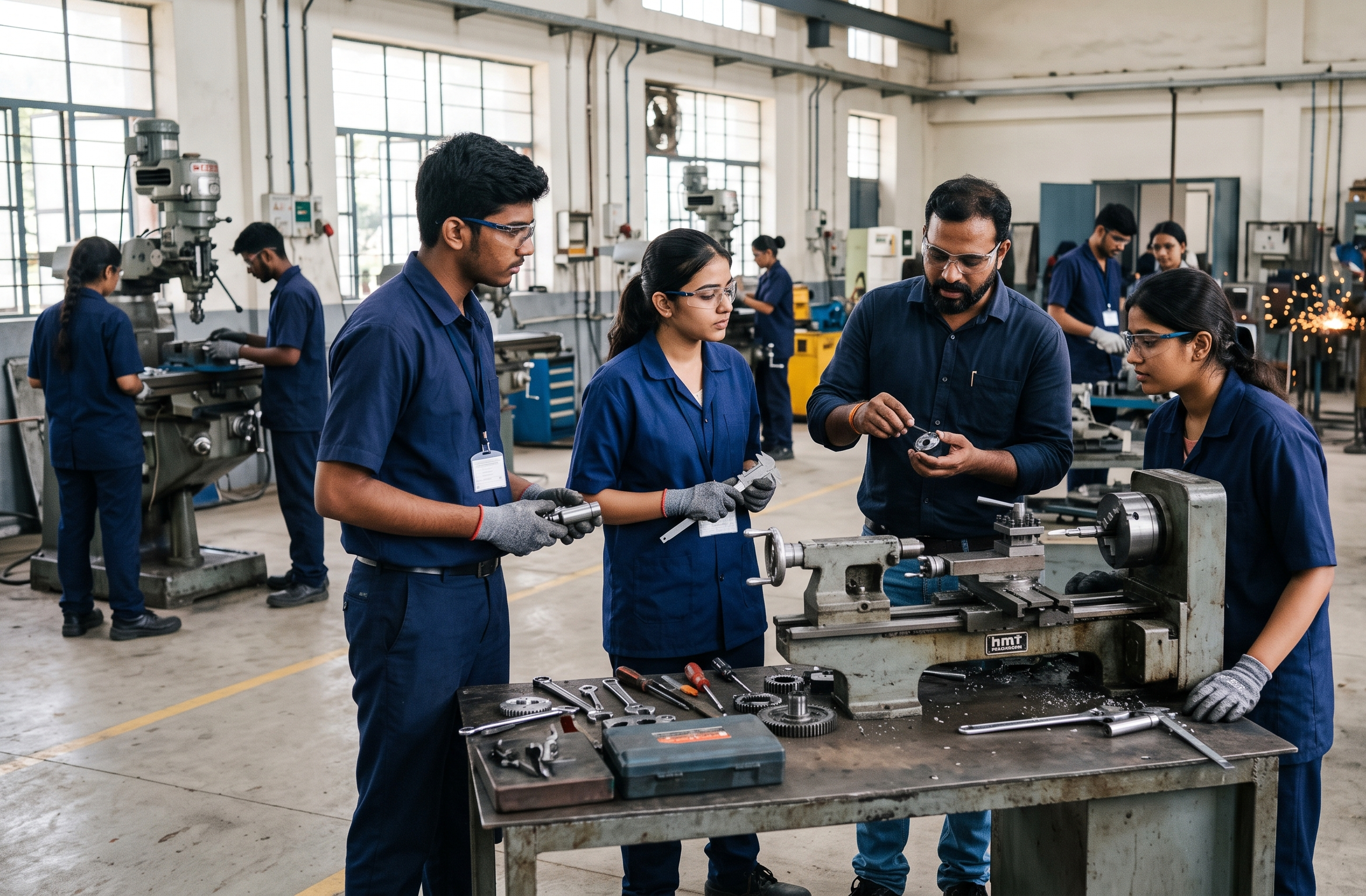
Employability skills for ITI students are the mix of technical know-how, communication, workplace habits, digital ability, and practical problem-solving that help a fresher function confidently on the job. A trade certificate shows what a student has studied. Employability skills show how well that student can actually work with people, tools, machines, processes, and workplace expectations.
At FIE, this becomes especially visible when ITI learners move from workshop practice into real industrial settings. Industrial internships, competency-based training, and regular workplace practice can close that gap. The goal is not simply to make students exam-ready. It is to make them useful on the shop floor from the beginning.
What Are Employability Skills for ITI Students?
Employability skills for ITI students are the non-trade abilities that technicians need alongside their core trade knowledge. A Fitter, Electrician, Welder, Electronics Mechanic, or COPA trainee may know the technical process, but that alone does not always mean the person is ready for a real workplace.
A technician also needs to listen carefully to instructions, communicate a problem, follow an SOP, maintain time discipline, work safely, and use basic digital tools. These details can sound small. On a busy shop floor, they are not.
The Directorate General of Training (DGT) treats Employability Skills as a mandatory component of the Craftsmen Training Scheme. Its curriculum includes dedicated hours for Employability Skills across CTS trades.
In practical terms, the most important employability skills fall into five areas:
- Communication: Workplace English, listening, speaking clearly, report writing, email, and basic digital communication.
- Teamwork & Collaboration: Working with supervisors, technicians, operators, and other trainees while understanding workplace roles and shift handovers.
- Problem-Solving & Reasoning: Identifying faults, understanding measurements, doing basic calculations, checking possible causes, and taking sensible corrective action.
- Digital Literacy: Using basic office software, email, digital forms, data entry, and workplace systems. Depending on the trade, this can also include CNC or HMI interfaces.
- Workplace Ethics & Safety: Attendance, punctuality, PPE, 5S, housekeeping, quality awareness, safe tool handling, and following instructions.
This is also where modern vocational education has moved beyond the idea that practical skill and soft skill are two completely separate things. They overlap constantly. A technician who notices a defect but cannot explain it clearly still creates a problem.
For ITI students, employability therefore means being able to do the task, explain the task, follow the process, and take responsibility for the result.
How Do Industrial Internships Bridge Classroom to Shop Floor?
Industrial internships give students something a workshop cannot fully reproduce: the experience of working inside an actual production system.
In an ITI workshop, a student may practice filing, wiring, welding, machining, or troubleshooting under controlled conditions. On a shop floor, the situation changes. There are production targets, safety rules, quality checks, supervisors, shift timings, documentation, and other workers depending on the same process.
A structured industrial internship helps students experience those realities before they enter full-time employment.
A useful internship should not simply mean sending students to a factory and asking them to observe. It should have defined learning outcomes, a workplace mentor, safety induction, practical tasks, and some form of assessment.
The industry-linked model can be organised into five practical steps:
- Skill Mapping: The ITI maps the student's trade, such as Fitter, Electrician, or Welder, against the employer's actual requirements and relevant competency outcomes.
- Onboarding & Safety Induction: Before touching equipment, the trainee learns workplace safety, PPE requirements, emergency procedures, 5S practices, machine rules, and basic shop-floor discipline.
- Rotation & Logbook: Students can rotate across selected workstations rather than staying in one corner for the entire internship. A daily logbook records tasks, observations, problems, and learning.
- Stipend & Mentorship: Where the arrangement is structured as apprenticeship training under applicable government provisions, stipend support may be available. Under the original NAPS framework, the Government of India shared 25% of prescribed stipend up to ₹1,500 per month with employers. The exact current applicability should always be checked against the latest apprenticeship rules and the establishment's registration.
- Assessment & Credit: The trainee's practical work can be assessed through task demonstrations, logbooks, supervisor feedback, and the requirements of the relevant ITI or apprenticeship framework.
The important point is simple: industrial exposure should have a learning plan. Otherwise, an internship can become little more than a factory visit spread across several weeks.
Students also learn things that are difficult to teach on a blackboard. How do you report a machine fault? What do you do when the first solution does not work? How carefully do you check a measurement when production depends on it?
Those are employability skills for ITI students in their most practical form.
What Is Competency-Based Training in Vocational Education?
Competency-based training (CBT) is an outcome-focused approach where students are assessed on whether they can actually demonstrate a competency rather than simply completing a fixed period of classroom or workshop instruction.
This approach fits closely with the National Skills Qualification Framework (NSQF), which defines qualifications through learning outcomes involving knowledge, skills, aptitude, employment readiness, and responsibility. The revised NSQF is explicitly outcome- and competency-based.
That distinction matters.
A student can attend every practical class and still struggle to perform a task independently. CBT tries to identify that gap earlier.
| Feature | Traditional Time-Based Training | Competency-Based Training (CBT) |
|---|---|---|
| Progress Logic | Students generally move according to the academic schedule | Progress is linked to demonstrated competency |
| Assessment | Strong focus on scheduled theory and practical examinations | Continuous evidence, demonstrations, and practical assessment |
| Pace | Mostly fixed | Can allow additional practice where required |
| Outcome | Marks, attendance, and course completion | Demonstrated skills and competency outcomes |
| Industry Link | Depends heavily on the individual ITI | Can include structured industry exposure and workplace assessment |
Take a Fitter student as an example. It is not enough to say that the student completed a certain number of hours of filing practice.
The more useful question is: Can the student produce the required result?
Can the student read a technical drawing? Can the student select the correct tool? Can the student achieve the specified tolerance? Can the student measure the finished work accurately? Can the student follow the safety procedure without being reminded every few minutes?
That is the thinking behind competency-based training.
It also aligns with the broader purpose of NSQF, which connects qualifications with knowledge, technical skills, employability, learning outcomes, and responsibility.
Soft Skills vs Technical Skills: What Do Employers Actually Want?
ITI students sometimes hear a confusing message: technical skills matter, but communication matters too. So which one is more important?
The honest answer is that employers generally need both.
A technician who communicates beautifully but cannot perform the trade task will not last. On the other hand, someone who can operate equipment but ignores safety instructions, arrives late, cannot report a defect, or refuses to work with a team creates a different kind of risk.
Think of early employment as having two connected sides:
- Technical ability: Can you perform the job safely, accurately, and according to the drawing, SOP, or work instruction?
- Work readiness: Can you communicate, follow discipline, learn from a supervisor, work with others, handle basic digital tasks, and respond sensibly when something goes wrong?
The second group is often underestimated.
For example, imagine a trainee electrician notices an abnormal sound in a motor. Knowing that something is wrong is useful. But the trainee also needs to stop or isolate the equipment according to procedure, communicate the observation, record the issue where required, and avoid taking an unsafe shortcut.
That combination is what employers are really looking for.
This is why Employability Skills curricula cover areas beyond basic communication. DGT's framework includes employability-focused learning alongside the student's trade training, while the broader NSQF framework also recognises employment readiness, soft skills, entrepreneurship, and responsibility as part of competency.
At Accurate Group of Institutions, the same principle can be reflected in practical preparation: mock interviews, workplace communication exercises, technical presentations, teamwork activities, digital documentation, and exposure to professional expectations should sit alongside technical learning rather than being treated as an afterthought.
A student who can explain a defect clearly to a supervisor and complete the required digital record is easier to train and easier to trust.
That matters during the first few months of employment.
How Can We Increase Women Participation in Industrial Education?
Women participation in industrial education remains an important part of improving access to technical careers. The issue is not simply admission numbers. A student needs a realistic pathway from counselling to training, internship, employment, and eventually career progression.
There are several practical barriers.
Parents may not know what opportunities exist in technical trades. Some families worry about transportation or workplace safety. Students may also hesitate when they do not see women working in the roles they are considering.
The answer is not to restrict women to a narrow set of trades. Instead, ITIs and employers can create clearer pathways and safer conditions.
Some useful measures include:
- Targeted Schemes: Government skill-development initiatives, women-focused ITIs, and institutional support can improve access to vocational education.
- Safe Infrastructure: Separate facilities, appropriate sanitation, security systems, trained staff, safe transport arrangements, and clear workplace policies make industrial exposure more practical.
- Trade Diversification: Women can pursue trades such as COPA, Electronics Mechanic, Draughtsman-related roles, Sewing Technology, and also traditionally male-dominated technical trades where suitable opportunities exist.
- Role Models: Women technicians, alumni, instructors, and industry professionals can give new students a much clearer picture of what a technical career can look like.
The bigger point is often missed. Employability skills for ITI students should also include career confidence and workplace awareness.
A technically capable student may still hesitate to apply for an industrial internship because she has never visited a manufacturing unit or spoken to a woman technician. Good counselling and structured exposure can change that.
For ITIs, this means inclusion should begin before the internship. Students need to understand the workplace, their rights and responsibilities, safety expectations, communication practices, and possible career routes.
Conclusion
Employability skills for ITI students are no longer something that can sit at the edge of technical education. A certificate tells an employer that a student completed training. Workplace behaviour, practical competence, communication, safety awareness, and the ability to solve routine problems show what that student can actually contribute.
Industrial internships make the transition less abrupt. Competency-based training makes learning more outcome-focused. NSQF provides a framework for connecting knowledge, skills, employability, and responsibility. Together, these approaches can help ITIs produce technicians who are not just qualified on paper, but more prepared for the conditions they will meet after joining an organisation.
For institutions such as Accurate Group of Institutions, the opportunity is to bring these elements together through practical training, industry interaction, communication practice, mentor support, and career-focused preparation.
FIE can support ITIs and industry partners in building this kind of ecosystem through employability frameworks, mentor development, competency-based training tools, and structured internship or apprenticeship linkages. The aim is straightforward: help students move from learning a trade to actually working in the trade.