Charting Your Course: Key Types of Industrial Education Programs and Their Career Prospects
Choosing an education program is easier when you understand where that program can actually take you. Industrial education is not limited to traditional trades or workshop-based training anymore. It now covers a much wider range of career-oriented programs, including vocational trades, advanced manufacturing, engineering technology, healthcare support, and digital skills.
The important difference is that these programs connect learning with practical work. Instead of focusing only on theory, students learn how tools, technologies, equipment, software, and industry processes work in real situations.
For students planning their careers, that practical connection matters. A person interested in machines may find a natural fit in mechatronics or manufacturing technology, while someone comfortable with computers may prefer networking, cybersecurity, or industrial software. Similarly, students interested in healthcare can explore specialised allied-health training.
Understanding the types of industrial education programs can therefore help students compare their options, identify the skills they need, and choose a pathway that matches their interests and career plans.
What Are the Main Types of Industrial Education Programs?
Industrial education includes several pathways, and each develops a different combination of technical knowledge and practical ability. While programs vary between institutions and countries, the major categories generally include vocational and technical training, advanced manufacturing, engineering technology, healthcare-related technical education, and IT and digital skills.
The right choice depends on more than the name of the course. Students should consider the equipment they will use, practical hours, curriculum, industry certifications, internship opportunities, and the types of jobs available after graduation.
1. Vocational and Technical Training Programs
Vocational education is one of the most established forms of industrial education. These programs prepare students for specific occupations where practical ability is central to the job.
Common areas include:
-
Electrical work
-
Plumbing
-
Welding and fabrication
-
Automotive service
-
HVAC and refrigeration
-
Construction technology
-
Industrial maintenance
A good vocational program does not simply teach students how to perform individual tasks. It also introduces workplace safety, equipment handling, measurement, troubleshooting, maintenance procedures, and professional standards.
For example, an electrical student may spend considerable time learning circuit fundamentals and safety procedures before progressing to practical installation and fault-finding exercises. Likewise, an automotive student needs experience with diagnostic equipment rather than relying solely on textbook descriptions of vehicle systems.
Career opportunities can include technicians, maintenance workers, electricians, mechanics, fabricators, and other skilled trade professionals. In many cases, additional licensing or certification is necessary before a person can work independently.
2. Advanced Manufacturing and Engineering Technology
Manufacturing has changed considerably with automation, robotics, computer-controlled machinery, and digital production systems. As a result, industrial education has expanded beyond traditional machine operation.
Advanced manufacturing and engineering technology programs may cover:
-
Robotics and automation
-
Mechatronics
-
CNC machining
-
CAD and CAM
-
Industrial control systems
-
Production technology
-
Quality control
-
Industrial instrumentation
Students in these programs often work with equipment and software that mirror technologies used in modern manufacturing environments. Practical exposure is particularly important because employers need people who can understand both the technical principles and the operation of industrial systems.
For instance, someone studying mechatronics may need to understand mechanical components, electrical circuits, sensors, programmable systems, and automated machinery. The ability to troubleshoot across these areas can be more useful than knowing one subject in isolation.
Career paths may include manufacturing technician, automation technician, CNC technician, quality technician, CAD operator, maintenance specialist, or production technology professional.
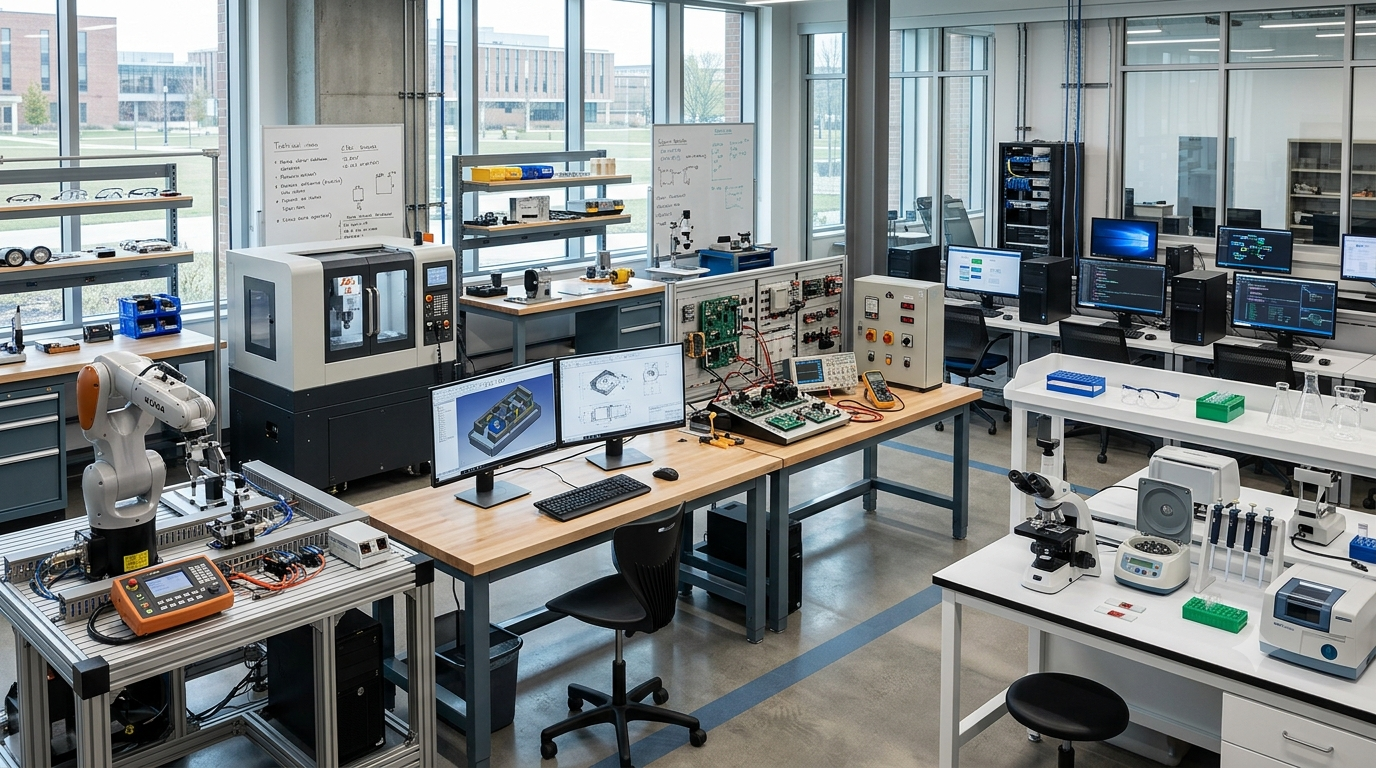
Why Practical Labs Matter
A laboratory can make a significant difference in technical education. Students should look beyond the word "lab" in a course brochure and ask what they will actually do there.
Will they operate machines? Build circuits? Use CAD software? Program controllers? Diagnose faults? Work with sensors? Interpret technical drawings?
These details provide a much clearer picture of the practical value of a program.
For students exploring FIE and CSIP, practical learning can be particularly valuable when programs connect technical concepts with industry-oriented skills. A useful learning environment should give students opportunities to understand tools, technologies, processes, and workplace practices rather than relying entirely on classroom theory. When evaluating any industrial education program, students should look at the specific facilities, curriculum, faculty expertise, practical exposure, and industry-oriented activities offered by the particular program.
3. Healthcare and Allied Health Programs
Industrial education also extends into healthcare through technical and allied-health programs. These courses prepare students for specialised support roles that require practical knowledge, accuracy, and familiarity with medical procedures or equipment.
Examples include:
-
Medical assisting
-
Pharmacy technology
-
Surgical technology
-
Dental laboratory technology
-
Medical laboratory technology
-
Diagnostic support roles
These programs usually combine classroom learning with laboratory, clinical, or simulated practical experience. Students may learn about medical terminology, equipment, documentation, safety procedures, patient interaction, and specialised technical processes.
Healthcare is a particularly detail-sensitive field. A student needs more than theoretical knowledge because small errors can have practical consequences. Consequently, training often places strong emphasis on procedures, accuracy, hygiene, safety, and professional conduct.
Career opportunities vary according to the qualification and local regulations. Some roles also require registration, certification, or licensing before graduates can practise.
4. IT and Digital Skills in Industrial Education
Digital technology now influences almost every industry, so IT skills have become an important part of modern industrial education.
Programs may focus on:
-
IT support
-
Networking
-
Cybersecurity
-
Data analytics
-
Cloud technologies
-
Software development
-
Database management
-
Industrial software applications
These programs are particularly relevant to students who enjoy problem-solving and working with technology.
For example, an IT support professional may troubleshoot hardware and software issues, configure systems, manage user access, and document technical problems. A cybersecurity professional works with security controls, monitoring, risk management, and incident response. Meanwhile, a data-focused role may involve collecting, cleaning, analysing, and presenting information for business decisions.
The practical component matters here too. Students should have opportunities to work with operating systems, networks, databases, development environments, security tools, or data platforms rather than studying concepts exclusively through lectures.
5. Certifications and Licenses That Can Strengthen Career Prospects
A qualification provides the educational foundation, but industry certifications can sometimes provide additional evidence of specific skills.
The relevance of a certification depends on the occupation and region. Examples include:
-
OSHA safety training: Relevant to workplace safety in applicable industrial environments.
-
CompTIA certifications: Commonly used to demonstrate foundational IT and cybersecurity knowledge.
-
AWS certifications: Relevant to cloud computing roles.
-
HVAC/R certifications: Applicable to heating, ventilation, air-conditioning, and refrigeration work.
-
Healthcare certifications: Depending on the occupation, recognised credentials may be required or preferred.
One important correction for students researching welding careers: AWS generally refers to the American Welding Society in the welding context, rather than Amazon Web Services. Welding credentials should therefore be checked carefully against the exact occupation and jurisdiction.
Certifications should not replace practical education. Instead, they can complement it by demonstrating knowledge in a defined technical area.
How Should Students Choose an Industrial Education Program?
The most useful approach is to start with the career rather than the course title.
First, identify the type of work that interests you. Do you prefer machines, computers, construction, healthcare equipment, design, repair, or production systems?
Next, examine the actual curriculum. Look for practical modules, laboratory hours, workshops, internships, projects, and technical software or equipment.
Then check entry requirements and progression opportunities. Some programs lead directly to employment, while others provide a foundation for further study.
It is also worth researching local employers and job descriptions. If several employers repeatedly ask for CAD skills, PLC knowledge, a particular certification, or experience with a specific software platform, that information can help you judge whether a program teaches relevant skills.
Finally, examine career support. Resume assistance, interview preparation, internships, employer interactions, technical competitions, and placement guidance can all help students move from education into employment. However, students should assess what an institution actually provides rather than relying only on broad placement claims.
What Career Prospects Can Industrial Education Offer?
Career prospects differ considerably by specialisation, qualification level, location, experience, and industry demand. There is no single career outcome for industrial education.
A vocational graduate may enter a skilled trade. An engineering technology graduate may work with automated production systems. An IT graduate may support networks or develop software. An allied-health graduate may work in a clinical or laboratory environment.
The common factor is practical competence.
Employers generally need people who can apply what they have learned. That means students should develop more than examination knowledge. They should learn how to troubleshoot problems, follow procedures, communicate with colleagues, use technical tools safely, document their work, and adapt when technology changes.
This is also why industry exposure can be valuable. Internships, workshops, live projects, demonstrations, and interactions with professionals can help students understand how classroom concepts translate into workplace responsibilities.
What Should Students Look for in a Quality Industrial Education Program?
Before enrolling, create a simple checklist.
Curriculum: Does it teach current technical skills?
Practical learning: How much time will students spend in laboratories, workshops, simulations, or projects?
Equipment: Are students exposed to tools and technologies relevant to the field?
Faculty: Do instructors have relevant academic and industry experience?
Industry exposure: Does the institution provide internships, expert sessions, projects, or employer interactions?
Certifications: Are relevant professional credentials included or supported?
Career support: Does the institution provide structured assistance with internships, resumes, interviews, and employer connections?
Further education: Can the qualification lead to advanced study or additional specialisations?
These questions make it easier to compare programs based on substance rather than marketing language.
Conclusion
Industrial education has evolved into a broad career-focused field covering skilled trades, advanced manufacturing, engineering technology, healthcare support, and digital careers. Each pathway develops a different set of practical skills and leads toward different employment opportunities.
The best starting point is therefore not simply asking which program is popular. Instead, students should ask what kind of work they want to perform and which skills that work requires.
A well-designed industrial education program should connect theory with practice, introduce students to relevant tools and technologies, and prepare them for the realities of their chosen industry. Whether the goal is to become a technician, automation professional, healthcare support specialist, or IT professional, choosing a program based on practical training and genuine career relevance can create a stronger foundation for the next stage of professional life.