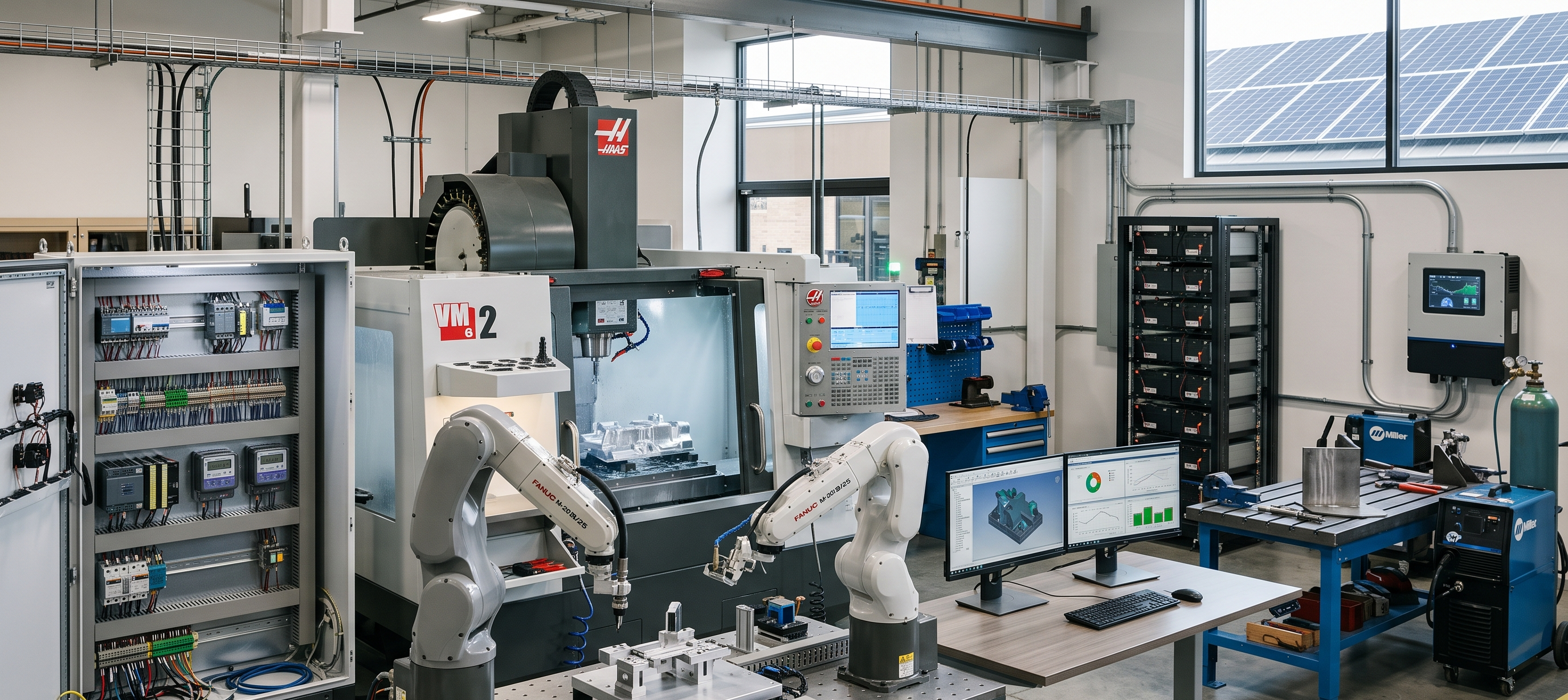
Career Opportunities After Industrial Education: Pathways to High-Demand Jobs
Industrial education is closely connected to the world of work. Instead of spending years studying concepts without knowing how they apply, students in career-focused technical programs learn skills that can be used in workshops, manufacturing facilities, technology environments, energy systems, and other industrial settings.
That practical focus creates several career pathways.
A student trained in CNC technology may move toward precision manufacturing. Someone interested in electrical systems can explore industrial maintenance or control systems. Another student may choose robotics, IT, renewable energy, welding, or HVAC. The options are broad, but they have one thing in common: employers need people who can actually operate, maintain, troubleshoot, and improve technical systems.
For students considering career opportunities after industrial education, the important question is not simply whether a particular job is "in demand." It is whether the education program builds the technical foundation, practical experience, and professional skills required for that job.
What Careers Can You Pursue After Industrial Education?
Industrial education can lead to careers across manufacturing, construction, maintenance, energy, automation, information technology, and technical services.
Some common career pathways include:
- CNC machinist and CNC programmer
- Industrial electrician
- Welder and fabrication technician
- HVAC technician
- Robotics technician
- Maintenance technician
- Quality control inspector
- CAD/CAM technician
- Renewable energy technician
- IT support specialist
- Network technician
- Industrial automation technician
The actual opportunities depend on the student's qualification, technical specialization, location, experience, and employer requirements.
For example, a student who completes a manufacturing-focused program may begin in a machine-operation or production role and later move into CNC programming, quality control, or production supervision. Similarly, an electrical student may begin with installation and maintenance work and gradually specialise in industrial controls, automation, or instrumentation.
So, industrial education does not necessarily lead to one fixed job. It can provide a technical base from which a student develops a more focused career.
Why Are Skilled Technical Professionals in Demand?
Modern industries are changing quickly. Manufacturing facilities now use automation, robotics, connected sensors, digital monitoring systems, and computer-controlled equipment. At the same time, conventional technical work still requires people who understand electrical systems, mechanical equipment, fabrication, maintenance, and safety.
This creates an interesting situation.
Technology can automate certain tasks, but automated systems still need people to install, configure, monitor, maintain, troubleshoot, and improve them.
For instance, an automated production line may contain robotic arms, sensors, motors, PLCs, conveyors, and control software. If a sensor stops working, someone needs to identify the fault. If a PLC program needs modification, a trained technician must understand the control logic. If a motor repeatedly fails, a maintenance professional needs to investigate the underlying problem rather than simply replace the component.
This is where practical technical education becomes useful.
Industrial education can prepare students for this environment by combining technical theory with laboratory exercises, equipment-based learning, projects, and industry-oriented training.
High-Demand Career Pathways After Industrial Education
1. CNC Machinist and Manufacturing Technician
CNC technology plays an important role in precision manufacturing. CNC professionals work with computer-controlled machines to produce components according to specific dimensions and technical drawings.
Training can include:
- CNC machine operation
- Technical drawing interpretation
- Measurement and tolerances
- Tool selection
- Machine setup
- CNC programming
- Quality inspection
- Workplace safety
A student entering this field should not focus only on machine operation. Understanding measurements, materials, tooling, and quality requirements can make a significant difference in day-to-day work.
With experience, a professional may move toward CNC programming, production planning, quality control, or specialised manufacturing roles.
2. Industrial Electrician
Industrial electricians work with electrical systems used in factories, production environments, commercial facilities, and technical installations.
Their responsibilities may involve:
- Electrical wiring
- Motor controls
- Control panels
- Electrical testing
- Preventive maintenance
- Fault diagnosis
- Industrial safety systems
Practical training is especially important here. Reading a circuit diagram is one skill; safely testing and troubleshooting the actual circuit is another.
Students should therefore look for programs that provide controlled laboratory practice with electrical components, testing instruments, control circuits, and motor systems.
Depending on the location and type of work, additional licenses or certifications may also be required.
3. Robotics and Automation Technician
Robotics and automation are creating technical roles that sit between traditional engineering and modern digital systems.
Automation technicians may work with:
- Industrial robots
- PLCs
- Sensors
- Actuators
- Motor drives
- Pneumatic systems
- Human-machine interfaces
- Industrial communication networks
The work can involve installation, programming, troubleshooting, maintenance, and system testing.
A useful training program should allow students to work with actual automation components rather than learning PLC logic only from textbooks. Even small laboratory systems can help students understand how sensors, controllers, motors, and software interact.
4. Welding and Fabrication Professional
Welding remains an important technical skill across fabrication, construction, manufacturing, repair, and maintenance.
Students can learn processes such as different arc-welding methods, along with:
- Material preparation
- Joint design
- Technical drawings
- Welding safety
- Measurement
- Fabrication
- Inspection
- Equipment handling
Practical repetition matters greatly. Welding is not a skill that can be mastered simply by reading about it. Students need controlled practice to develop consistency, accuracy, equipment awareness, and safe working habits.
Professional certifications can also be relevant, depending on the type of welding work and local industry requirements.
5. HVAC Technician
Heating, ventilation, air-conditioning, and refrigeration systems require technicians who understand mechanical, electrical, and refrigeration principles.
HVAC training can cover:
- System installation
- Preventive maintenance
- Refrigeration principles
- Electrical controls
- Fault diagnosis
- Equipment servicing
- Safety procedures
The role can involve both technical troubleshooting and physical work. Students should therefore understand the practical nature of the occupation before choosing it as a career.
6. Maintenance Technician
Maintenance professionals help keep industrial equipment operational. Their work can include preventive maintenance, inspections, repairs, component replacement, and troubleshooting.
Modern maintenance is not limited to fixing broken machinery. Many facilities use sensors and monitoring systems to identify potential problems before equipment fails.
As a result, maintenance professionals increasingly need knowledge of mechanical systems, electrical components, automation, instrumentation, and digital monitoring tools.
This makes maintenance a good example of how traditional industrial skills are becoming increasingly connected with technology.
Career Opportunities in Renewable Energy
Renewable energy has created another technical pathway for industrial education graduates.
Students can develop skills related to:
- Solar photovoltaic systems
- Battery storage
- Electrical connections
- Energy monitoring
- Solar system installation
- Equipment maintenance
- Energy efficiency
A renewable energy technician may work with installation, testing, maintenance, system monitoring, or technical support.
However, students should look carefully at the depth of a renewable-energy course. A basic installation course and an advanced program covering electrical systems, system design, storage, monitoring, and maintenance do not provide the same skill set.
IT and Digital Careers After Industrial Education
Industrial careers are becoming increasingly digital. Manufacturing plants, warehouses, energy systems, and technical organisations depend on networks, databases, software, cloud services, and cybersecurity.
This creates opportunities for students with digital and IT skills.
Potential roles include:
- IT support technician
- Network technician
- Systems support professional
- Cybersecurity technician
- Data support specialist
- Industrial software support professional
Practical learning is important here as well.
An IT student should ideally work with operating systems, networks, databases, virtual environments, troubleshooting tools, and security systems. Likewise, a cybersecurity student benefits from practising controlled security scenarios rather than studying security terminology alone.
For students interested in the intersection of technology and industry, this can create opportunities to work with both digital systems and physical industrial infrastructure.
How FIE and CSIP Can Support Career-Focused Learning
For organisations such as FIE and CSIP, career-focused industrial education can be structured around the skills employers actually use. The value of such training depends heavily on the quality and relevance of the curriculum, practical sessions, technical resources, and industry exposure.
Practical education can include laboratory exercises, technical projects, workshops, demonstrations, internships, expert interactions, and industry-oriented assignments.
For example, a student studying automation should ideally get opportunities to work with controllers, sensors, motors, and programming environments. Similarly, a student pursuing digital technology should gain experience with relevant software, networks, databases, or security tools.
Students should also examine the faculty profile, laboratory infrastructure, practical hours, certification opportunities, and internship arrangements before selecting a program.
Do Industrial Education Programs Help With Job Placement?
Education alone does not guarantee employment. However, a career-focused program can make the transition easier when it combines technical skills with practical exposure and career preparation.
Several factors can support this transition.
Industry Exposure
Industrial visits, internships, apprenticeships, and interactions with technical professionals can help students understand workplace expectations.
Practical Projects
Projects give students something concrete to demonstrate during interviews. A working automation model, CAD design, electrical project, software application, or technical maintenance project can communicate practical ability more clearly than a list of subjects.
Career Preparation
Resume development, interview preparation, technical assessments, and job-search guidance can help students present their skills effectively.
Industry Certifications
Relevant certifications can supplement a qualification by demonstrating knowledge in a specific technical area. Their importance depends on the occupation and employer.
Students should also be realistic about placement claims. Instead of asking only about a headline placement percentage, they should ask which companies recruit, which roles graduates receive, what qualifications are required, and whether the reported figures apply to their specific program.
What Skills Matter Beyond Technical Knowledge?
Technical knowledge gets a student into the field, but workplace performance depends on more than technical ability.
Employers may also expect professionals to:
- Follow safety procedures
- Read technical documentation
- Communicate clearly
- Record maintenance or production information
- Troubleshoot systematically
- Work with teams
- Manage time
- Adapt to new equipment and software
These skills become increasingly important as professionals move into positions with greater responsibility.
A technically strong employee who cannot document a fault or communicate a maintenance issue clearly may struggle in a real industrial environment. Conversely, someone who combines technical competence with reliable communication can gradually take on more complex responsibilities.
What Are the Long-Term Career Prospects?
Industrial education does not have to stop at the first job.
With experience and additional training, professionals can progress into roles such as:
- Senior technician
- Lead technician
- Maintenance supervisor
- Production supervisor
- Quality specialist
- Automation specialist
- Field service professional
- Technical trainer
- Project coordinator
- Operations professional
The exact progression depends on the technical field.
For example, a maintenance technician may specialise in automation or predictive maintenance. A CNC professional may move into programming or production planning. An electrician may develop expertise in industrial controls. An IT technician may progress toward networking, cloud infrastructure, or cybersecurity.
Continuous learning matters because equipment, software, safety standards, and production methods change over time.
Is Industrial Education a Good Route for Students Seeking Direct Career Skills?
For students who prefer applied learning and want to develop occupation-specific technical skills, industrial education can provide a direct route into technical careers.
The key is choosing the right specialization.
Students should compare the curriculum, practical hours, laboratory equipment, faculty expertise, certifications, internships, industry interaction, and career support before enrolling. They should also research actual job descriptions for the career they want.
That last step is often overlooked.
A course may sound impressive, but the real test is whether its skills match the requirements employers currently list for entry-level roles.
Conclusion
Career opportunities after industrial education span skilled trades, advanced manufacturing, automation, electrical systems, renewable energy, maintenance, IT, and other technical fields. The strongest pathways are built around practical competence rather than theory alone.
Students can improve their career prospects by choosing a relevant specialization, gaining hands-on experience, completing meaningful projects, developing workplace skills, and adding certifications where they genuinely matter.
Industrial careers are also not necessarily static. A technician can specialise, move into supervision, develop expertise in emerging technologies, or continue into advanced technical roles.
The first step is understanding what a particular career actually requires. From there, the right industrial education program can provide the technical foundation needed to enter the workforce and continue developing professionally.