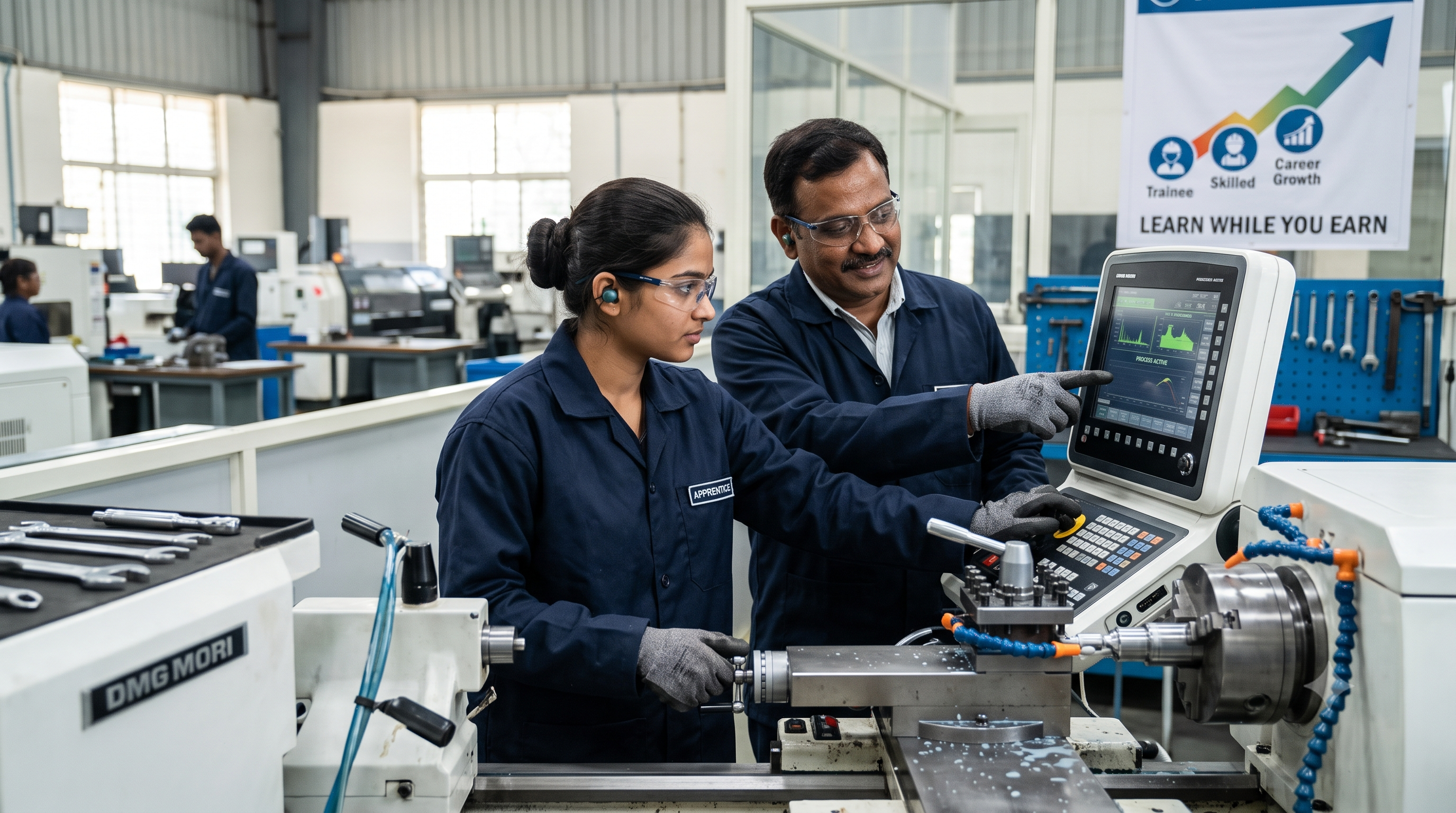
Apprenticeship in India is a structured way for students and young job seekers to gain practical workplace experience while receiving a stipend. Under government-supported apprenticeship programmes such as NAPS and NATS, learners train with employers, develop job-ready skills, and earn valuable industry experience alongside their formal qualifications.
For many ITI students, diploma holders, and graduates, this makes apprenticeship a useful bridge between completing a course and entering full-time employment.
What Is Apprenticeship in India and How Does It Work?
An apprenticeship is more than a short-term internship. It is a structured training arrangement between an apprentice and an establishment, where the learner develops occupational skills through supervised practical work.
The basic idea is straightforward: learn the job by actually doing the job.
Depending on the trade and programme, an apprentice may spend most of the training period working in a factory, workshop, office, laboratory, service centre, or other professional environment. The practical component is supported by related theoretical instruction, so students understand not only what to do but also why a particular process is followed.
For example, an ITI fitter may work with production equipment, learn preventive maintenance procedures, follow workplace safety practices, and understand quality requirements. Similarly, an electronics apprentice could gain experience with assembly, testing, troubleshooting, or quality inspection.
The apprenticeship system generally involves three key participants:
- Apprentice: A learner who meets the educational and age requirements for a particular trade or apprenticeship category.
- Establishment: A company, factory, workshop, office, or other eligible organisation that provides practical training.
- Training and government authorities: They support registration, regulation, assessment, certification, and implementation of apprenticeship programmes.
The apprenticeship contract defines important details such as the trade, training period, stipend, and responsibilities of the parties involved.
Why Is Apprenticeship Important for Students?
There is a common problem after completing an ITI, diploma, or technical course: a student may have the qualification but very little experience working in an actual industrial environment.
That gap matters during recruitment.
Employers often look for people who can understand workplace instructions, follow safety procedures, operate equipment correctly, maintain basic documentation, and work as part of a team. These abilities are difficult to develop through classroom learning alone.
That is where apprenticeship becomes useful.
Practical experience
An apprentice gets exposure to real equipment, processes, tools, workplace standards, and production environments. Instead of only studying how a machine works, the learner may actually assist with operating, maintaining, testing, or inspecting it under supervision.
Earn while you learn
A major attraction of apprenticeship in India is the stipend. Instead of paying for another training programme, eligible apprentices receive financial support while gaining experience.
The actual stipend depends on factors such as qualification, trade, employer, and applicable government rules. Some employers also offer amounts above the prescribed minimum to attract suitable candidates.
Industry-ready skills
Technical knowledge becomes more useful when students know how it is applied at work.
An electrician, for instance, needs more than knowledge of circuits. They also need to understand safety procedures, tools, maintenance schedules, fault identification, documentation, and workplace discipline. Apprenticeship helps develop this combination.
Better understanding of career options
Apprenticeship also gives students an opportunity to experience a particular industry before committing themselves to it as a long-term career.
A learner might discover that production, maintenance, quality control, CNC operations, or technical service suits them better than they initially expected.
What Are the Types of Apprenticeship in India?
There is no single apprenticeship route for every learner. Different programmes cater to different educational backgrounds.
| Apprenticeship type | Typical eligibility | Common duration | Suitable for |
|---|---|---|---|
| Designated Trade Apprentice | ITI or relevant trade qualification | Varies by trade | Electrician, fitter, welder, COPA and other ITI trades |
| Optional Trade Apprentice | Depends on the employer and trade | Varies | Newer and employer-specific job roles |
| Graduate Apprentice | Degree holder | Usually around 12 months | Engineering and other graduates |
| Technician Apprentice | Diploma holder | Usually around 12 months | Polytechnic and technical diploma students |
| Technician (Vocational) Apprentice | Relevant vocational qualification | Usually around 12 months | Vocational education students |
For ITI learners, designated trade apprenticeships are particularly relevant. However, optional trades have also expanded opportunities into newer areas where employers need specific practical skills.
Graduate and diploma apprenticeships are commonly associated with the National Apprenticeship Training Scheme (NATS), while NAPS primarily supports apprenticeship expansion across designated and optional trades.
The exact eligibility and duration should always be checked against the current programme and establishment requirements before applying.
What Is NAPS and How Does the Stipend Work?
The National Apprenticeship Promotion Scheme (NAPS) was introduced to encourage employers to engage apprentices and expand apprenticeship opportunities across India.
NAPS has evolved over time, with NAPS-2 placing greater emphasis on digital processes and direct transfer mechanisms.
Under the current framework, the employer is responsible for paying the prescribed stipend to the apprentice. Government support is provided according to the applicable NAPS rules and limits.
The important point for students is this: do not assume that every apprenticeship will pay the same amount.
Stipend can vary according to the apprentice's educational qualification, trade, employer, location, and applicable government notifications. Some companies offer considerably more than the prescribed minimum, particularly for technical roles where there is strong demand for skilled trainees.
Before accepting an apprenticeship, students should therefore check:
- Monthly stipend amount
- Training duration
- Trade or job role
- Working location
- Shift requirements
- Accommodation or transport, if offered
- Possibility of employment after training
- Assessment and certification requirements
This small checklist can prevent confusion later.
How to Apply for Apprenticeship in India
The application process is largely digital, although the exact selection process can differ between employers.
1. Register on the apprenticeship portal
Create your apprentice profile and enter your personal, educational, and other required details.
2. Complete your profile
Keep your educational certificates, identity details, bank information, and other required documents ready. Make sure your name and date of birth are consistent across documents.
3. Search for suitable opportunities
Look for apprenticeships based on your qualification, trade, location, and preferred industry.
Don't apply randomly. An electrician should prioritise electrical maintenance, industrial electrical work, and related roles rather than applying to every vacancy available.
4. Attend the employer's selection process
Depending on the establishment, selection may involve document verification, an interview, aptitude assessment, trade test, or other screening.
Your ITI marks matter, but so does your understanding of basic trade concepts and your willingness to work in an actual industrial environment.
5. Complete the apprenticeship contract
After selection, the required apprenticeship contract and formalities are completed. Once the training begins, attendance, practical learning, assessments, and stipend payments follow the applicable programme and employer rules.
Which Sectors Offer Apprenticeship Opportunities?
Manufacturing remains an important area for apprenticeship in India, especially for ITI and diploma students.
Automotive and manufacturing
Automobile plants, component manufacturers, and engineering companies regularly require trainees for roles related to fitting, welding, machining, production, maintenance, quality, and CNC operations.
Electronics and electrical
Electronics manufacturing and electrical equipment companies can provide exposure to assembly, testing, inspection, maintenance, and production processes.
Construction and infrastructure
Electricians, technicians, welders, and other skilled workers can find apprenticeship opportunities connected with construction and infrastructure projects.
Healthcare and life sciences
Some apprenticeship roles are available in areas such as laboratory support, healthcare services, and pharmaceutical operations, depending on the qualification and employer.
Retail, logistics and services
Apprenticeship opportunities have also expanded beyond traditional factory jobs. Logistics, warehouse operations, customer service, retail, banking-related support, and other service roles can offer alternative pathways.
For students choosing between opportunities, the best option is not necessarily the one with the highest stipend. A role that provides meaningful hands-on training, exposure to relevant equipment, and a strong learning environment may be more valuable for long-term career growth.
How Can Students Get More Value From Apprenticeship?
Simply completing an apprenticeship does not automatically make someone highly skilled. The quality of learning depends heavily on how actively the apprentice participates.
Take notes about machines, processes, tools, and recurring problems. Ask supervisors why a particular procedure is followed. Learn workplace documentation instead of ignoring it. Pay attention to safety practices.
Also, don't restrict your learning to the exact task assigned to you.
If you're working as a production trainee, understand how quality inspection fits into the production process. If you're in maintenance, learn how preventive maintenance schedules are prepared. If you're working with CNC equipment, understand basic drawings, measurements, tooling, and quality checks.
That broader understanding can make your apprenticeship experience much more useful when you begin applying for permanent positions.
FIE and its Curriculum Synced Industrial Program (CSIP) can help learners understand the connection between academic knowledge, practical skills, and real industry expectations. For students exploring technical and vocational career pathways, industry-oriented learning and practical exposure can make the transition from education to employment more structured and meaningful.
Is Apprenticeship a Good Career Starting Point?
For a student who has completed an ITI, diploma, vocational programme, or relevant degree, apprenticeship can be a practical first step into the workforce.
It provides something that a certificate alone cannot: evidence of having worked in a real professional environment.
The experience can help during future interviews because candidates can discuss actual tasks, equipment, workplace situations, safety procedures, and problems they encountered during training.
However, students should look at apprenticeship realistically. It is training, not a guarantee of permanent employment. Some employers may absorb successful apprentices into regular roles, while others may not have vacancies when the training ends.
Therefore, use the apprenticeship period to build skills, understand the industry, maintain a good attendance record, and prepare for the next job opportunity at the same time.
Conclusion
Apprenticeship in India offers a practical route for students who want to move from classroom learning into real employment environments. The combination of supervised workplace training, a stipend, industry exposure, and recognised certification can help learners develop skills that employers actually use.
For ITI students and diploma holders especially, the apprenticeship period should be treated as more than a temporary job. It is a chance to understand how an industry operates, build technical confidence, learn professional discipline, and create a stronger foundation for the first full-time career move.
As apprenticeship opportunities continue expanding across manufacturing, electronics, services, infrastructure, and emerging technical sectors, students should compare opportunities carefully and choose roles that provide genuine learning along with financial support.